Sonnet 29
Sonnet 29 is a deeply moving exploration of isolation, envy, and the redemptive power of love. Studying it will enhance your ability to analyse the sonnet form, structural shifts (the volta), and the contrast between material and emotional wealth—key skills that examiners reward heavily in AO2.
Study Notes
Overview
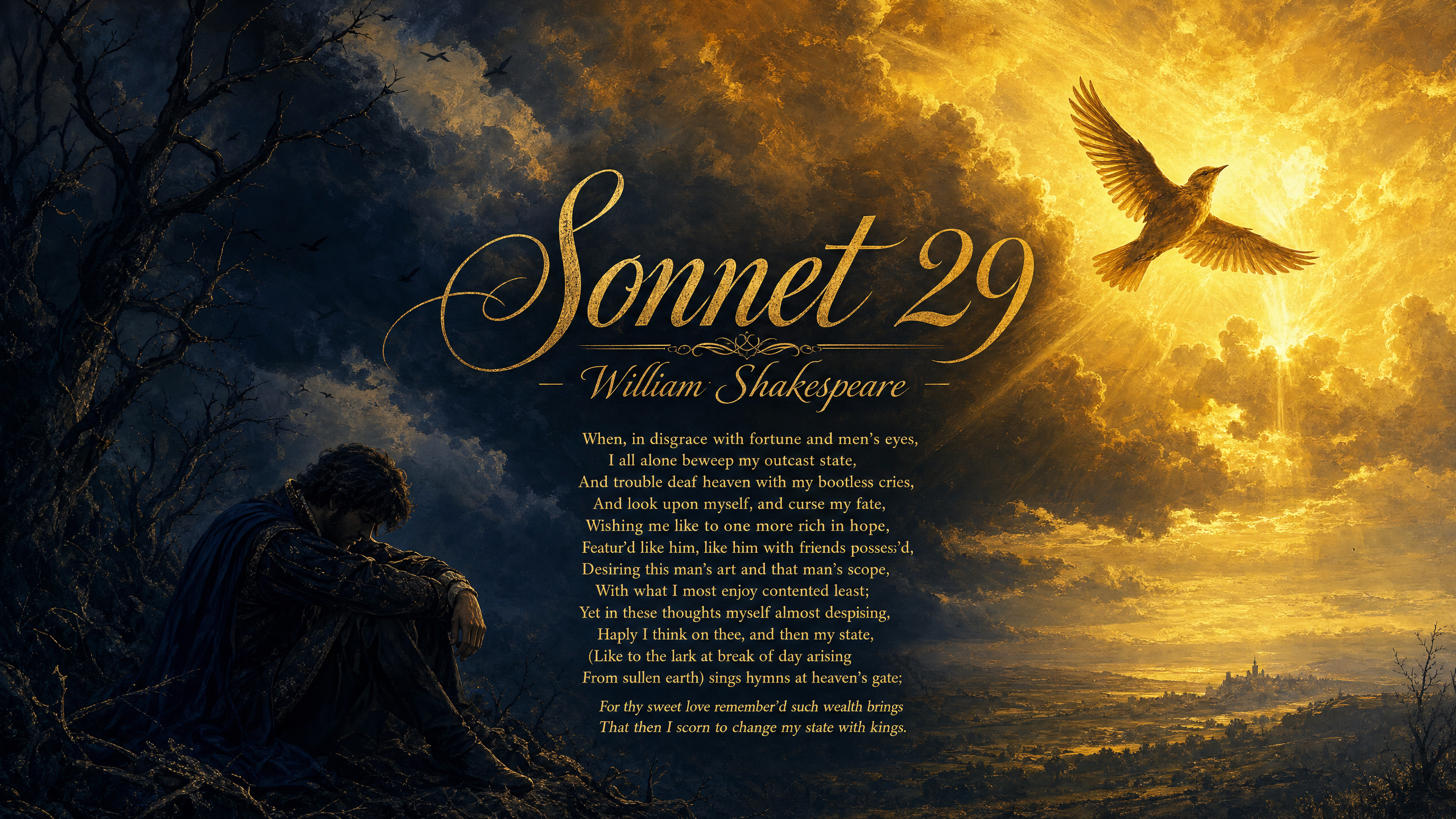
Sonnet 29 by William Shakespeare is a 14-line poem that captures a profound emotional journey. The speaker begins in a state of utter despair, feeling ostracised by society and abandoned by heaven. He envies the talents, looks, and prospects of other men. However, at line 9, a structural turning point known as the volta occurs. The spontaneous memory of his beloved completely transforms his state of mind, elevating his spirit and leading him to conclude that the emotional wealth provided by love is far superior to the material wealth of kings. Examiners look for perceptive analysis of how Shakespeare uses structure (the shift from octave to sestet) and language (such as the central lark simile) to present this dramatic emotional shift.
Audio Revision
Listen to our 10-minute deep-dive podcast on Sonnet 29:
Plot/Content Overview
Lines 1-4: The speaker describes feeling completely alone, cursed by fate, and ignored by heaven. He weeps over his outcast state.
Lines 5-8: He compares himself obsessively to others, wishing he had their hope, their friends, their artistic skills, and their intellectual scope. He is dissatisfied with everything he usually enjoys.
Lines 9-12 (The Volta): Just as he is despising himself the most, he accidentally thinks of his beloved. This thought makes his spirit soar, compared to a lark rising at dawn to sing at heaven's gate.
Lines 13-14 (The Couplet): He concludes that remembering this sweet love brings him such immense wealth that he wouldn't trade places even with a king.
Themes
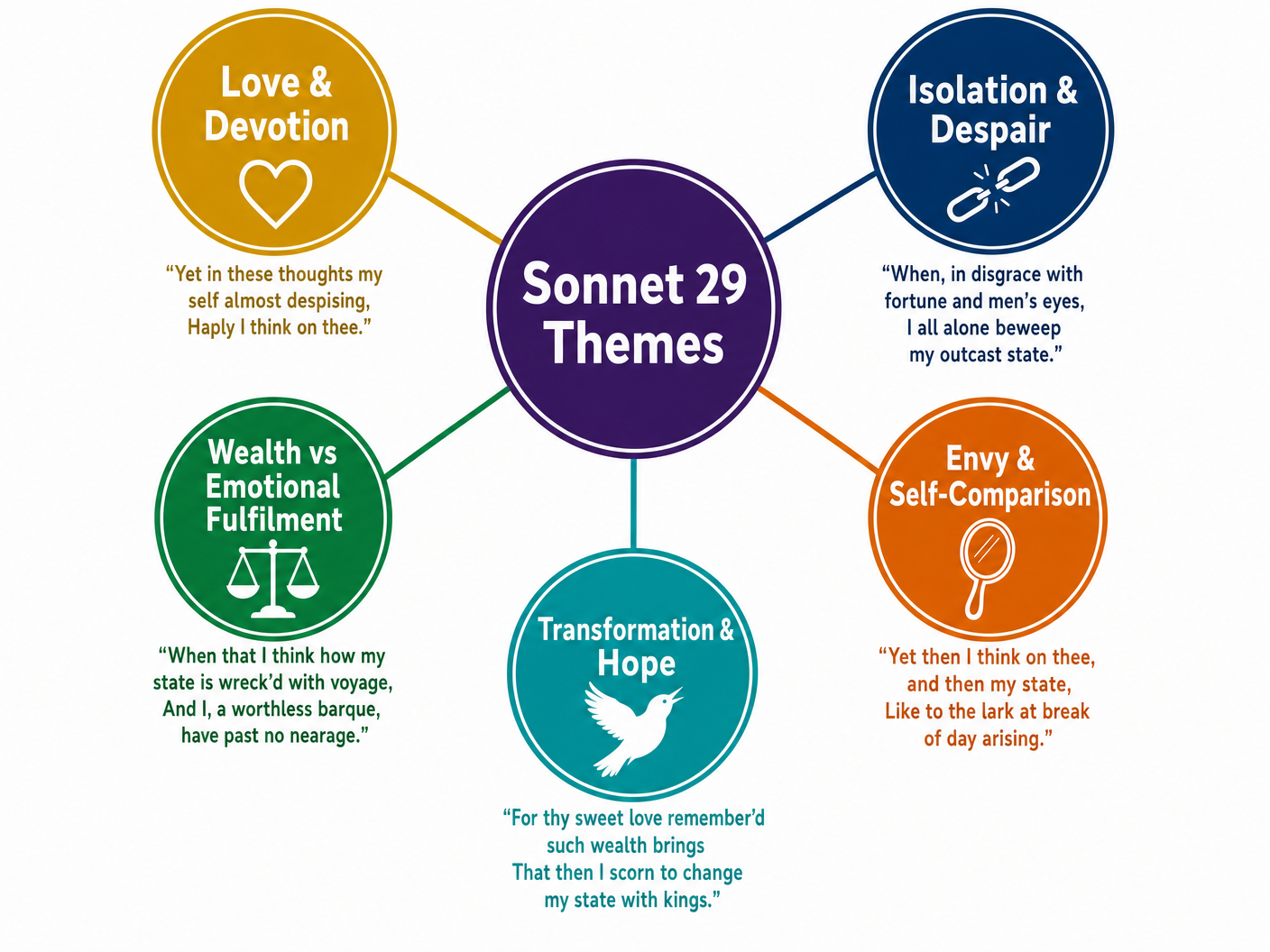
Theme 1: Isolation and Despair
The poem opens with a stark presentation of depression and social alienation. The speaker feels entirely disconnected from both society and the divine.
Key Quotes:
- "I all alone beweep my outcast state" (Line 2) - The adjective "outcast" highlights his sense of social rejection, while the intensive "all alone" emphasises his total isolation.
- "trouble deaf heaven with my bootless cries" (Line 3) - The personification of heaven as "deaf" shows his spiritual abandonment; "bootless" (useless) emphasises the futility of his prayers.
Theme 2: Wealth vs Emotional Fulfilment
Shakespeare contrasts the material power and status of kings with the internal, emotional richness that love provides.
Key Quotes:
- "Desiring this man's art and that man's scope" (Line 7) - The repetition of "man's" highlights his obsessive envy of others' talents and societal positions.
- "For thy sweet love remember'd such wealth brings / That then I scorn to change my state with kings." (Lines 13-14) - The concluding couplet redefines "wealth" from financial/social status to emotional abundance.
Theme 3: The Transformative Power of Love
Love is presented not just as a comforting feeling, but as a force capable of rescuing the speaker from the depths of despair and elevating him to spiritual joy.
Key Quotes:
- "Haply I think on thee" (Line 10) - The adverb "haply" (by chance) suggests that love's power is spontaneous and unforced.
- "Like to the lark at break of day arising" (Line 11) - This central simile uses natural imagery to represent the soaring, joyful transformation of the speaker's soul.
Character Analysis
The Speaker
Role: The poetic voice expressing deep inner turmoil and eventual salvation through love.
Key Traits: Insecure, envious, passionate, reflective.
Character Arc: Moves from intense self-loathing and despair (lines 1-8) to transcendent joy and gratitude (lines 9-14).
Essential Quotes:
- "myself almost despising"
- "I scorn to change my state with kings"
Writer's Methods
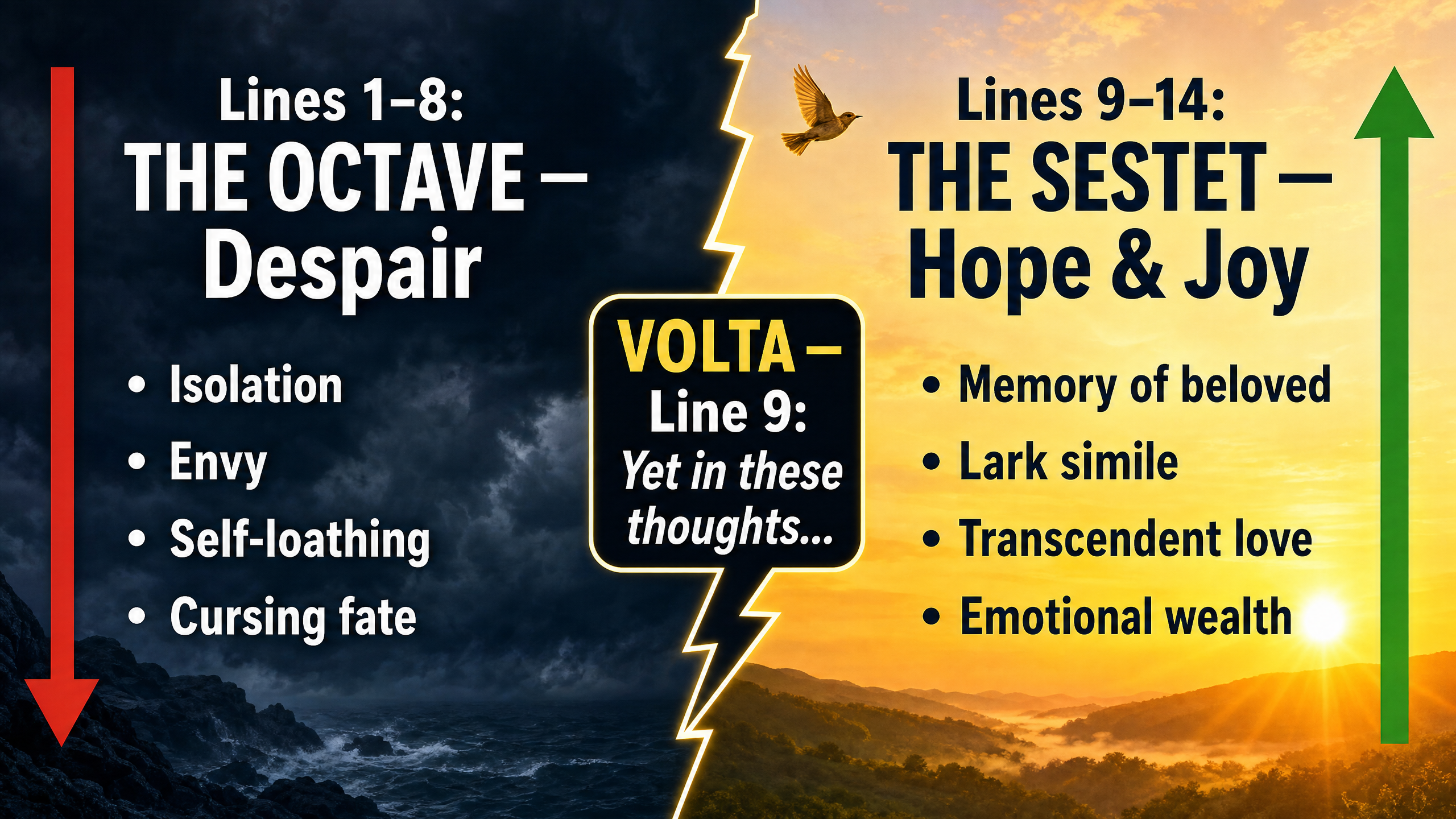
Structure - The Volta: The most significant structural feature is the volta (turn) at line 9: "Yet in these thoughts...". This pivot shifts the poem from the negative, despairing octave (first 8 lines) to the positive, hopeful sestet (final 6 lines). Examiners award high marks for explaining how this structure mirrors the speaker's sudden emotional shift.
Form - The Sonnet: Written in Shakespearean sonnet form (three quatrains and a rhyming couplet) in iambic pentameter. The strict, heartbeat-like rhythm contrasts with the turbulent, chaotic emotions described in the first half.
Imagery - The Lark: The simile "Like to the lark at break of day arising / From sullen earth" is crucial. The lark symbolises hope and spiritual elevation, while "sullen earth" represents the heavy despair he is leaving behind. Notice how the lark sings at "heaven's gate"—the heaven that was "deaf" in line 3 is now accessible through love.
Context
Renaissance Humanism: During the Renaissance, there was a shift towards valuing individual human experience and emotion over strict social hierarchy. Sonnet 29 reflects this by ultimately arguing that personal, emotional connection (love) is more valuable than the highest social status (kingship).
Patronage and Status: In Shakespeare's time, a poet's livelihood depended heavily on the patronage of wealthy nobles. The speaker's anxiety about "fortune and men's eyes" and his envy of others' "art" and "scope" reflects the precarious social and financial position of a writer in Elizabethan England.
Visual Resources
2 diagrams and illustrations
Interactive Diagrams
1 interactive diagram to visualise key concepts
Conceptual Flow Outline
The Emotional and Structural Journey of Sonnet 29
Worked Examples
2 detailed examples with solutions and examiner commentary
Practice Questions
Test your understanding — click to reveal model answers
How does Shakespeare present the theme of isolation in Sonnet 29? (30 marks)
Hint: Look at the first four lines. How does the speaker feel about his relationship with society ('men's eyes') and God ('deaf heaven')?
Explore how Shakespeare uses nature imagery to convey emotion in Sonnet 29. (30 marks)
Hint: Focus heavily on the lark simile and the contrast with 'sullen earth'.
Compare how poets present the desire for something they do not have in Sonnet 29 and one other poem. (30 marks)
Hint: Focus on lines 5-8 where the speaker desires 'this man's art and that man's scope'.
How does Shakespeare present the relationship between wealth and happiness in Sonnet 29? (30 marks)
Hint: Look closely at the final rhyming couplet and how the definition of 'wealth' changes.